
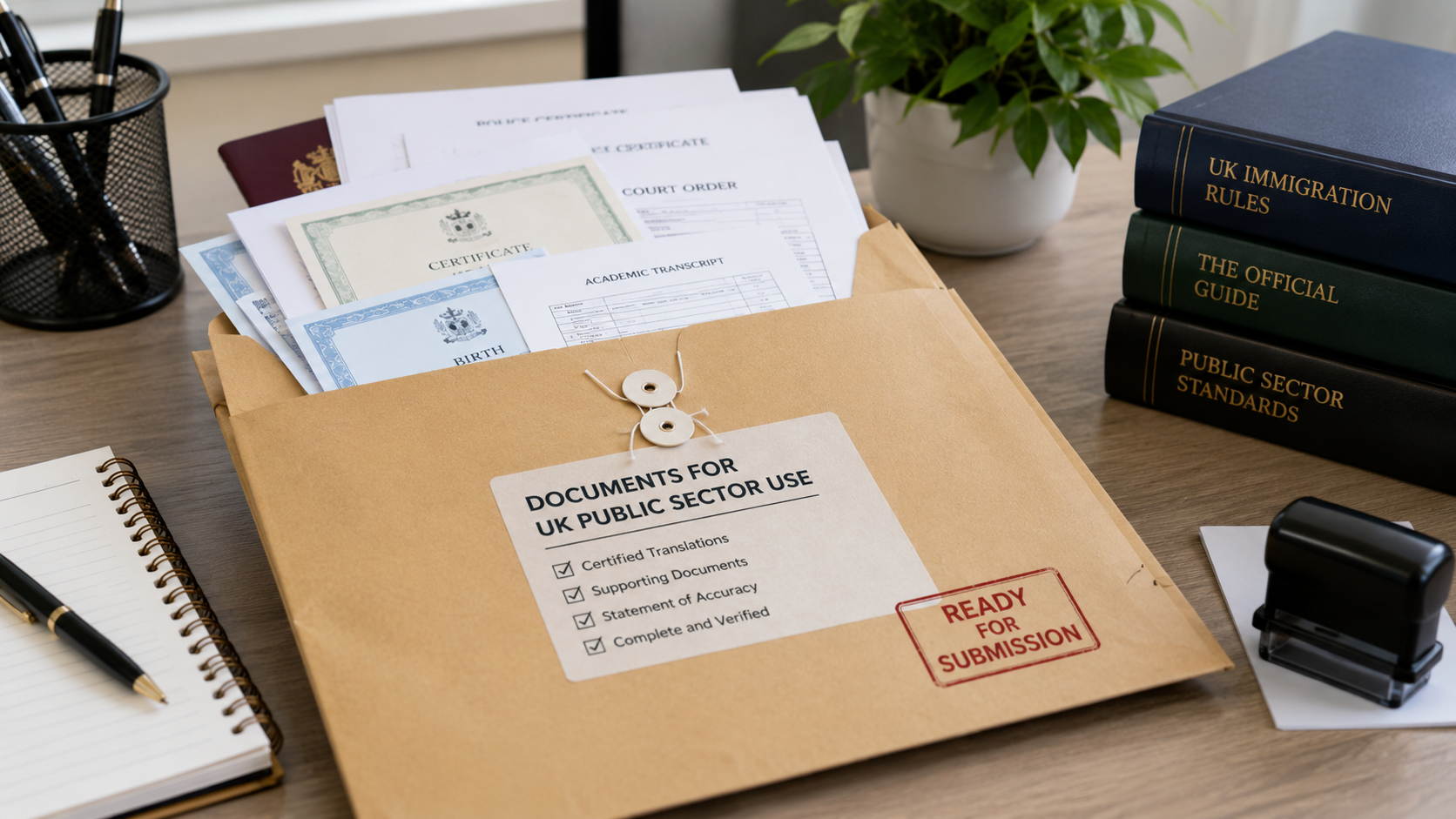
Start with the receiving organisation, not the service label
If a UK authority, overseas court, embassy, university or employer has asked for an official translation, first obtain its exact requirements. In everyday use, ‘official translation’ can mean a certified translation, but some destinations request a notarised translation, a sworn translator’s signature or document legalisation. These are different processes, and no single format is guaranteed for every country.
Which certification type do I need?
A certified translation includes an accuracy statement from the translator or translation business. A notarised translation involves a separate notarial step, while a sworn translation may need an authorised translator recognised under a particular country’s rules. An apostille is a legalisation certificate for eligible documents and is not a translation. The correct choice depends on the receiving body and the document’s destination. Our notarised versus sworn translation guide explains the distinction.
Check when an apostille is required
For a UK-issued document going overseas, ask whether the recipient needs legalisation of the original, a certified copy, a translator’s signature or another eligible document. For FCDO legalisation, consult GOV.UK’s current legalisation guidance. It explains what documents the UK Legalisation Office can process. Requirements for foreign-issued documents and overseas courts are different, so do not pay for an apostille merely because an application involves another country.
How to prepare a complete source document
Send every page needed by the recipient. Make sure scans show both sides where relevant, stamps, marginal notes, registration numbers, signatures and handwritten entries. Identify the source and target languages, describe any illegible sections, and avoid cropping relevant information. Never ask the translator to invent a missing date or adjust a name to match another record.
What affects the price and turnaround?
The quote depends on the language pair, text volume, complexity, certification format, deadline and delivery requirements. Check whether postage, notarisation, sworn translation and legalisation are included or arranged separately. For urgent work, request a confirmed completion time before relying on it. Translation completion and international postal delivery should be treated as different milestones.
Check the result before you submit it
Compare every source page with the translated copy, especially names, dates, numbers and visible seals. Check that the certification statement meets the receiving body’s written rules. If you notice an error, request a corrected version from the provider rather than altering a signed certified PDF. The guide to rejected certified translations lists common issues and how to investigate them.
First-time checklist
Before ordering, confirm: (1) the destination organisation and country, (2) the exact documents and languages, (3) the required certification method, (4) complete readable copies, (5) the true submission deadline, and (6) digital or paper delivery. If any point remains uncertain, share the written instructions via the contact form for a document-specific enquiry rather than choosing a service based on the word ‘official’ alone.