Bank Statement Translation UK: What It Is and When You Need It
Bank statement translation UK is the accurate translation of a statement from one language into another while preserving bank and account details, transactions, dates, currencies and balances. It may be needed for mortgages, legal matters, financial reviews or official applications. Not every organisation requires certification: check what the intended recipient actually asks for.
A translation explains the information in the statement; it does not verify that the bank issued it, establish that the funds are available or guarantee acceptance by a lender or authority. The translation should be complete enough for the reader to compare it with the source document without changing figures or financial meaning.
For a document-specific service, see our certified bank statement translation page. For immigration, read our separate bank statement translation for UK visa guide, which covers route-specific UKVI evidence rather than general document preparation.
Upload Your Bank Statement & Start Order
Why You Might Need a Bank Statement Translated
Bank statements can form part of different application and document checks. Whether you need a translation—and whether it has to be certified—depends on the organisation receiving it. Common examples include:
- Mortgage and loan applications: a lender may request an English version of foreign-language account evidence for affordability or source-of-funds checks. Ask the lender about its preferred format.
- Solicitors and legal matters: translated statements may support probate, disclosure, family proceedings, financial disputes or the review of transactions. The required date range and certification depend on the matter.
- Accounting, audit and business: an accountant, buyer or company may need overseas account information translated to understand statements, reconcile transactions or review supporting records.
- Immigration: some visa routes require specified financial evidence, but others do not. If a required statement is not in English or Welsh, follow the translation rules for the particular route.
- Other institutions: universities, insurers and overseas organisations may request a translated statement where it is relevant to their own processes.
A translated statement can make the original understandable, but it does not itself prove creditworthiness, ownership of funds or eligibility for an application. Follow the recipient’s written document requirements before ordering.

What Information Must a Bank Statement Translation Include?
For an accurate and usable financial translation, the reader must be able to match translated entries against the original. A full translation should preserve, where present, the following:
- Account and bank details: the account holder’s name, bank and branch names, account number, IBAN, SWIFT/BIC and any displayed identifiers.
- Statement dates: the issue date, period covered and dates of each transaction.
- Balances and movements: opening and closing balances, credit and debit amounts, charges, fees, interest and running balances.
- Transaction descriptions: payees, payer names, transfer details, references, notes and relevant headings.
- Currency and number formats: original currency codes, signs, decimal marks and negative amounts.
- Additional content: page numbers, footnotes, stamps, handwritten annotations and other relevant visible text.
Do not change or convert account balances into pounds sterling. The translated statement should reproduce the bank’s recorded amounts and currency; foreign-exchange calculations are a separate exercise. Numbers, transaction signs and bank references should be checked against the source, especially where a table is dense.
The English layout should allow transactions and columns to be checked line by line. It does not need to reproduce decorative features exactly, but it should not omit entries or disguise missing information. Unreadable text should be queried or identified as illegible, never guessed.
Bank Statement Translation Requirements in the UK
There is no single rule requiring every translated bank statement in the UK to be certified. Some recipients accept a professional translation; others ask for a signed certificate, an original statement, a certified copy or further evidence. The recipient decides what it needs.
For general UK certification, GOV.UK guidance on certifying translations calls for a written statement confirming that the translation is true and accurate, with the date, the translator’s full name and contact details.
For some immigration routes the standard is more specific. For example, GOV.UK’s visitor visa guidance requires full, independently verifiable translations of supporting documents not in English or Welsh, including confirmation of accuracy, a date, the translator’s full name and signature, and contact details. Check your exact route rather than assuming every visa has identical evidence rules.
Certified translation versus certified copy
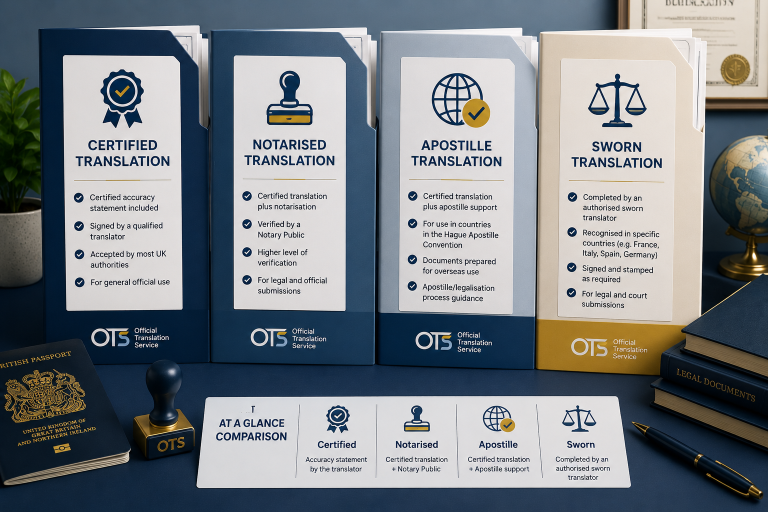
A certified translation confirms the accuracy of translated text. A certified copy confirms a copy matches a source document. Neither automatically verifies the underlying bank statement or confirms the account holds eligible funds. If your recipient requests notarisation, a sworn translation or a particular signed format, tell the translation provider before work starts.
For the standard UK service and certification options, see our certified translation services.
How to Get Your Bank Statement Translated
The process can be completed online. Prepare the whole relevant bank statement and make sure it is clear enough for every entry to be read.
- Check your recipient’s instructions. Confirm whether it needs the full statement, which dates must be covered, the language, certification and delivery format.
- Upload complete source files. A readable bank-issued PDF or clear scan is preferable to cropped screenshots. Include all relevant pages and any reverse-side notes.
- Start the order. Use the online order form and state the language pair, intended use, deadline and any exact certification requirements.
- Confirm scope and cost. The number of pages and transactions, table complexity and certification affect delivery and pricing.
- Review the translation. Compare account names, transaction dates, currency, signs and opening and closing balances with the original before submission.
If part of the original is blurred or damaged, request a clearer copy from the bank. Do not try to reconstruct an illegible amount or silently edit the original statement.
Bank Statement Translation Costs, Turnaround and Delivery
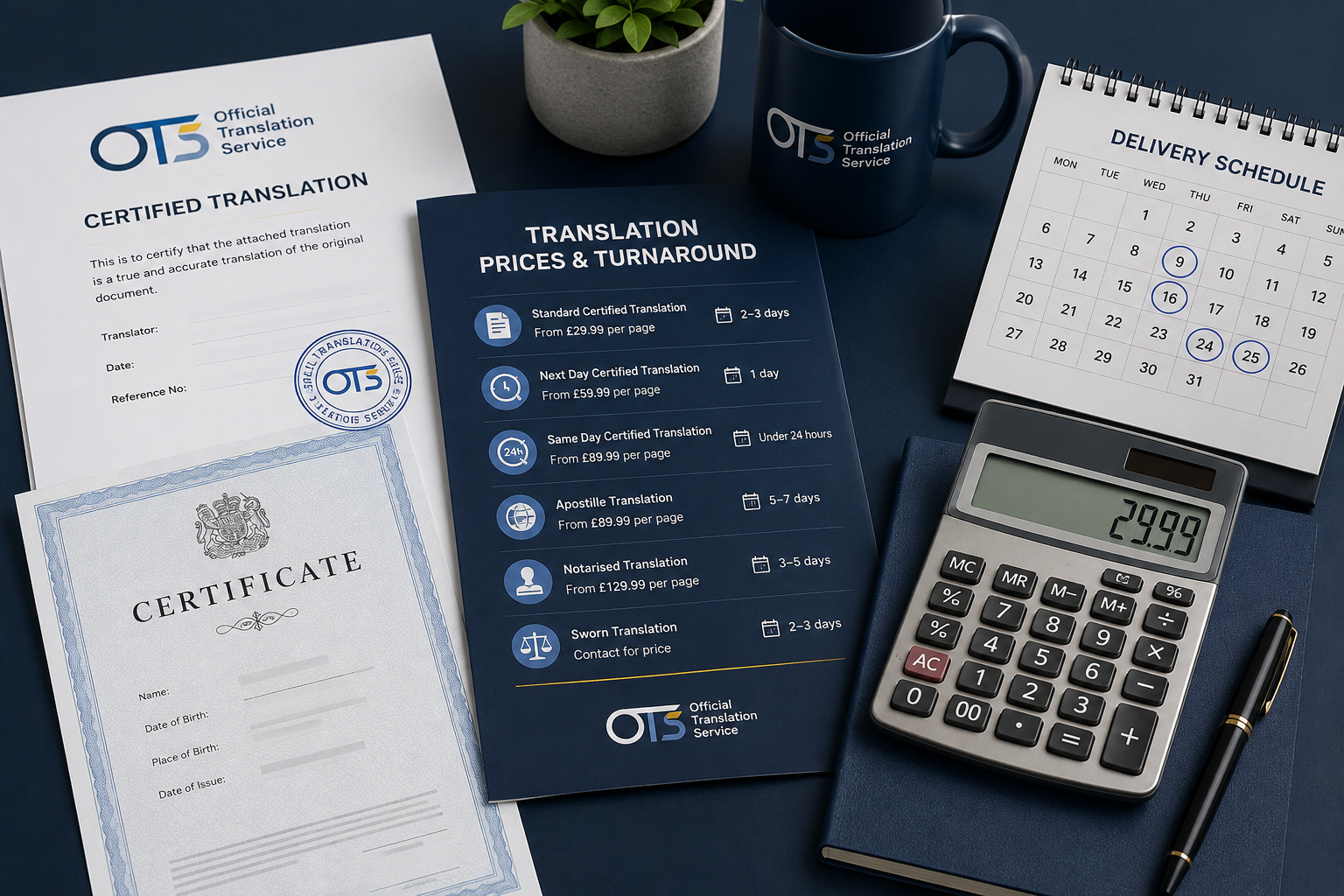
Pricing depends on the source and target languages, page count, number of transaction entries, formatting, certification, urgency and any printed delivery. A dense statement with several pages of figures may take more work than a short letter or certificate; headline per-page rates may not tell the full story.
- Short statements: a straightforward translation may be completed in around two to three working days, subject to the language pair and document review.
- Long or complex statements: multiple months, dense tables or unclear source documents can take longer to translate and check.
- Urgent delivery: express service may be available where capacity allows, but it must be confirmed for your specific file.
- Delivery format: the recipient may accept a PDF or may require a printed, signed version. Confirm its requirements before ordering.
Consult our translation prices page for general guidance, then upload your document to start your order so the final scope, price and delivery can be confirmed.
Choosing and Checking Your Bank Statement Translation
Look for clear explanations of the complete translation scope, financial terminology, checking process, certification format and delivery. Before submission, review the following items:
- All required statement pages and the correct date range are included.
- Account holder names, bank identifiers, transaction references and page numbers match.
- Credits, debits, minus signs, currency codes and totals remain unchanged.
- Tables are legible and line up with the correct transaction entries.
- Any certification statement has the details required by the recipient.
- The original statement or certified copy is attached if the receiving organisation requires it.
A statement can contain confidential financial and personal details. Only share the pages needed for the agreed purpose and check that you have permission to submit them. If your receiving organisation demands a full statement, ask before redacting account data or transactions. See our privacy policy for information about data handling.
Need a Bank Statement Translated?
Upload the complete document and tell us the language pair, receiving organisation and deadline. Our team can review the file and confirm the certification, price and delivery options before proceeding.
Upload Documents & Start Order
For document-specific details, return to the bank statement translation service.
Common FAQs About Bank Statement Translation
Does every bank statement need a certified translation?
No. The recipient determines whether a translation is needed and whether it must be certified. Check the exact written instructions for your application or transaction.
Can I translate my own bank statement?
You may translate information for personal use, but a self-translation might not satisfy official requirements. For a certified or independently verifiable translation, follow the receiving organisation’s rules and use an appropriate professional provider.
Should the translator convert a foreign-currency balance into GBP?
No. The translated statement should preserve the currency and amounts recorded by the bank. Currency conversion or an eligibility calculation is a separate task.
Do all transaction entries and pages need translating?
Where a full statement is required, all relevant pages, transactions, headings and notes should be included. Ask the receiving organisation before omitting pages or redacting details.
Can a downloaded or online bank statement be translated?
Yes. A readable PDF from an online bank account can be used as the source for translation. The recipient may have separate requirements for the authenticity or format of the source document.
How long does a bank statement translation take?
Turnaround depends on the length, language pair, density of transaction entries, formatting and certification. A short document may take around two to three working days, but confirm the deadline for your own file.
Is a certified translation the same as a certified copy?
No. A certified translation confirms translated wording is accurate, while a certified copy confirms a copy matches an original. The recipient may require one or both.
What if part of my statement cannot be read?
Provide a clearer copy from the bank if possible. Illegible text or figures should be identified and clarified rather than guessed.
How much does bank statement translation cost?
The price depends on language, number of pages and transactions, formatting, certification and turnaround. Upload the document to confirm the complete price before work begins.