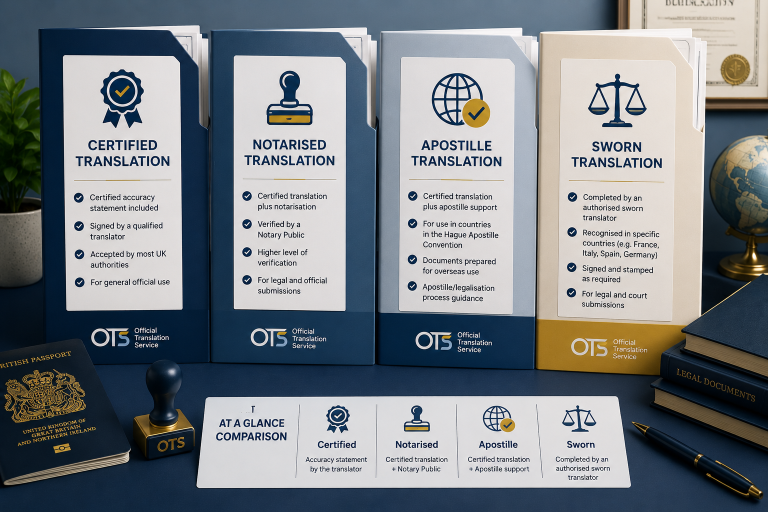
Understanding the Apostille Process in the UK
In the UK, the FCDO Legalisation Office can legalise certain official UK documents by checking whether the signature, stamp or seal matches its records and, if so, attaching an apostille. An apostille authenticates the origin of an eligible public document for use abroad; it does not confirm that every statement in the document is true, nor does it certify the accuracy of a translation.
You only need an apostille when the person or authority receiving the document says legalisation is required. Before applying, confirm whether they need a paper apostille or can accept an e-Apostille, and whether each document needs its own apostille.
Businesses may also need UK documents legalised for overseas transactions, but not every contract or company document is eligible or requires an apostille. The destination authority’s instructions and the Legalisation Office’s document-eligibility rules determine the correct route.
Step-by-Step Guide on How to Get an Apostille in the UK
Obtaining an apostille in the UK involves several steps, each critical to ensuring that your documents are properly legalised. Here’s a detailed guide on how to navigate the process:
- Check that the document can be legalised: The UK service legalises eligible UK-issued documents. Documents issued outside the UK must normally be legalised in the country where they were issued. Some UK documents may need a prior signature, certification or notarisation before the Legalisation Office can apostille them. If translation is also required, confirm whether the recipient wants the original, the translation, or a translator/notary signature legalised. See our Apostille Translation page for translation support.
- Apply through the current GOV.UK service: Applications for paper apostilles and e-Apostilles are made online. The service tells you what information and submission method are required for the option you choose.
- Submit the document as instructed: For a paper apostille, the online application will tell you how to send the document. For an e-Apostille, follow the digital submission instructions shown by the service. Do not send documents to an address copied from an old guide; the postal details are provided after you apply.
- Check the current service level, fee and timing: As of 15 September 2026, GOV.UK lists the standard paper apostille at £45 per document plus return delivery and says it usually takes up to 25 working days. The e-Apostille is £35 and is listed as taking up to 2 working days. Registered businesses have additional paper-based next-day/restricted-urgent options. These details can change, so confirm them on GOV.UK when you apply.
By following these steps, you can ensure that your documents are properly legalised and ready for use in your intended country.
FCDO Legalisation: What You Need to Know
The Foreign, Commonwealth & Development Office (FCDO) plays a pivotal role in the document legalisation process in the UK. The FCDO is responsible for issuing apostilles and ensuring that documents meet the necessary legal requirements for international use. Understanding the role of the FCDO is essential for anyone seeking to legalise documents.
For UK documents, the Legalisation Office’s process results in an apostille when the document is eligible. If the destination is outside the Hague Apostille Convention or has additional requirements, further embassy or destination-country legalisation may also be needed after the UK document has been apostilled. Check with the authority asking for the document.
Additionally, the FCDO also offers guidance on which documents require an apostille and the specific steps to follow. It is advisable to consult the FCDO’s official website or contact them directly for any queries regarding the legalisation process. This ensures that you are fully informed and prepared to navigate the requirements effectively.
The Document Legalisation Process Explained
The document legalisation process can vary depending on the type of document being legalised. Here’s an overview of the common types of documents and the legalisation requirements for each:
- Personal documents: UK birth, marriage and death certificates from public registries are examples of documents the Legalisation Office may be able to legalise. Whether you actually need an apostille depends on the foreign recipient.
- Academic documents: Degrees, transcripts and other educational records do not all follow one route. Some need a solicitor/notary or other recognised signature before legalisation. Check the current Legalisation Office eligibility requirements for the exact document.
- Business and legal documents: Companies House certificates, powers of attorney, contracts and other corporate/legal records can have different pre-legalisation requirements. Do not notarise automatically; check what the Legalisation Office and foreign recipient require.
While the process may seem straightforward, there are common pitfalls that applicants should avoid:
- Incomplete Applications: Ensure that all forms are filled out completely and accurately to avoid delays.
- Incorrect Document Types: Verify that your document is eligible for an apostille. If in doubt, consult the FCDO or your legal advisor.
- Assuming translation must come first: Translation and apostille are separate requirements. Ask the foreign recipient whether the original document, the translation, a notarial certificate or another item needs legalisation before deciding the order of steps.
By understanding the requirements for different document types and avoiding common mistakes, you can streamline the legalisation process and ensure that your documents are accepted abroad.
Apostille Stamp UK Guide: What It Looks Like and Its Significance
The apostille stamp is a distinctive certificate that is attached to the original document. It includes several key pieces of information, such as the country of origin, the name of the person who signed the document, and the date of issuance. The stamp also contains a unique identification number that can be used to verify its authenticity.
The apostille confirms the origin of the relevant signature, stamp or seal. It does not confirm the substantive validity of the document or guarantee that a foreign authority will accept it for a particular purpose. In some destinations, additional legalisation can still be required.
UK apostilles are issued by the FCDO Legalisation Office. The recipient can verify a UK paper or electronic apostille using the official GOV.UK verification service with the apostille number and issue date.
Common Questions About the Apostille Process
What is the apostille process in the UK?
It is the FCDO Legalisation Office process for authenticating the origin of eligible UK public documents by attaching an apostille.
How do I get an apostille in the UK?
Apply online through the GOV.UK legalisation service, choose the relevant paper or electronic option, pay the current fee and follow the submission instructions generated by the application.
What types of documents require an apostille?
There is no universal list of documents that “require” an apostille. Eligible UK public documents may need one when the foreign authority receiving them specifically asks for legalisation.
How long does the apostille process take?
Current GOV.UK timings vary by service. As of 15 September 2026, the standard paper service is listed as usually taking up to 25 working days, while an e-Apostille is listed as taking up to 2 working days. Always check the live service before applying.
Can I expedite the apostille process?
The Legalisation Office currently offers additional faster paper options for registered businesses, subject to the service conditions. Use the live GOV.UK page for current eligibility, fees and timing.
Tips for Ensuring a Smooth Apostille Process
To ensure a smooth apostille process, consider the following tips:
- Confirm what needs translation: If the foreign recipient requires an English or other-language translation, use a provider that can meet that recipient’s certification requirements. Do not assume the translation itself must be apostilled. For more details, visit our Certified Translation page.
- Double-Checking Document Requirements: Before submitting your documents, verify that you have met all requirements, including notarisation and translation, if necessary. This will help avoid delays and rejections.
- Staying Informed About Changes in Regulations: Keep abreast of any changes in the apostille process or legalisation requirements by regularly checking the FCDO website or consulting with legal experts.
By following these tips, you can navigate the apostille process more effectively and ensure that your documents are ready for international use.
Frequently Asked Questions
What is the apostille process in the UK?
A process used by the FCDO Legalisation Office to authenticate the origin of an eligible UK public document for use abroad.
How do I get an apostille in the UK?
Apply online through the GOV.UK legalisation service and follow the generated instructions for paper or electronic submission.
What types of documents require an apostille?
Eligible UK public documents vary. Check whether the foreign recipient actually requires legalisation and whether your document can be legalised by the UK service.
How long does the apostille process take?
Current service timings differ. As of 15 September 2026, GOV.UK lists standard paper legalisation as usually up to 25 working days and e-Apostille as up to 2 working days.
Can I expedite the apostille process?
Faster paper services currently exist for eligible registered-business applications. Check the live GOV.UK service for current conditions.
Current official reference: The GOV.UK Legalisation Office service is the source to use for document eligibility, current fees, processing times and application instructions. Apostille requirements also depend on the authority abroad that is asking for the document.