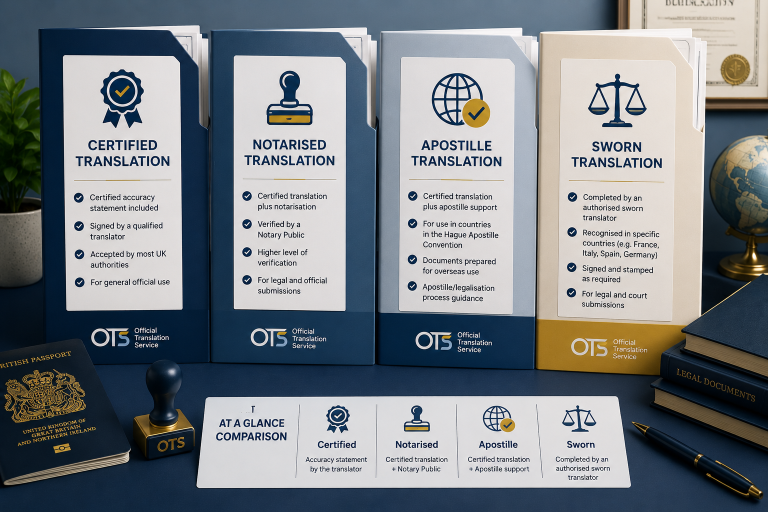
UK Government Translation Standards for Official Documents
This guide focuses specifically on the translation requirements, certification details and document checks that can apply when translated documents are submitted to UK authorities and public bodies. There is no single universal format used by every organisation, so the receiving body’s own instructions should always take priority.
Requirements vary by purpose. Some authorities ask for a complete translation with a signed statement confirming accuracy, the translation date, and details identifying the translator or translation company. Others may specify different wording, formatting, notarisation or legalisation steps. Check the exact submission instructions before ordering.
For a broader overview of translation work for councils, departments and public-sector organisations, see our government and public sector translation guide. If you need the service itself, use our government translation services page.
There Is No Single Universal UK Government Translation Standard
Different UK authorities publish different document requirements. A Home Office visa application, a court filing, a university application and a council submission do not necessarily use the same certification wording or evidence rules. The safest approach is to identify the receiving organisation first and follow its current instructions.
At the core of these standards is the need for precise and contextually accurate translations that reflect the original document’s intent, tone, and content. For instance, when translating legal documents such as contracts or court orders, even a minor mistranslation can alter the document’s meaning and lead to unintended consequences. Therefore, government translation standards are designed to minimise the risk of such errors.
For example, Home Office guidance for visa documents specifies information that should accompany translations submitted with relevant applications. Other public bodies may use their own guidance, so Home Office requirements should not be treated as a universal rule for every UK authority.
The important question is whether the translation meets the receiving body’s stated requirements and can be independently verified. Professional qualifications or membership of bodies such as ITI or CIOL can provide useful evidence of expertise, but they are not a universal statutory requirement for every certified translation submitted in the UK.
In summary, understanding and adhering to government translation standards in the UK is vital for anyone needing official translations. These standards safeguard the accuracy and legality of translated documents, thereby ensuring that they serve their intended purpose without complications.
Key UK Government Translation Requirements
Translation requirements differ according to the authority, application and document type. Common themes include completeness, accuracy, clear identification of the translator or translation provider, and enough information for the receiving organisation to verify the translation.
Do not assume that every UK authority requires membership of a particular professional body. Instead, check whether the receiving organisation specifies who may prepare the translation and what certification statement or identifying information must accompany it.
Documentation types that typically require translation include:
- Immigration Documents: This includes visas, residency applications, and any supporting documents that must be submitted to the Home Office.
- Legal Documents: Court orders, contracts, and other legal papers often require certified translations to ensure they are legally binding.
- Educational Certificates: Transcripts, diplomas, and degrees must be accurately translated for university admissions or employment purposes.
- Medical Records: For healthcare services, accurate translations of medical records are essential to ensure proper treatment and care.
- Financial Documents: Bank statements, tax returns, and other financial records may require translation for various official processes.
Some official processes, including relevant Home Office submissions, ask for a statement confirming that the translation is accurate together with the translation date, translator details and contact information. Other bodies may request a different format, so this should not be treated as a blanket rule for every government submission.
Furthermore, certain documents may have specific formatting requirements. For instance, the Home Office may require translations to be presented in a particular layout or include specific details, such as the translator’s contact information and credentials. Understanding these nuances is crucial for ensuring that translations meet government standards.
In conclusion, the key UK government translation requirements encompass certification, documentation types, and adherence to specific formatting and declaration standards. Meeting these requirements is essential for anyone seeking to ensure that their translated documents are accepted by governmental authorities.
When a Public Sector Body May Ask for a Certified Translation
A public sector body may ask for a certified translation when a document is not in English or Welsh and needs to be reviewed as part of an official process. This can apply whether the document is being used for an application, an appeal, a legal matter, a public service request, or an administrative record update.
Common situations include:
- Submitting immigration or visa documents to a UK authority
- Providing civil status documents such as birth, marriage, divorce, or death certificates
- Presenting overseas educational certificates to a university or public institution
- Supplying legal documents for court, tribunal, or solicitor use
- Providing medical records, vaccination documents, or healthcare-related evidence
- Translating police certificates or criminal record documents
- Submitting financial, employment, or tax documents for official review
- Providing translated business or company records for public-sector procurement or compliance checks
The receiving organisation may have its own instructions, so it is always sensible to check the exact requirements before ordering the translation. A professional translation provider can also help identify whether a certified, notarised, apostilled, or standard translation is likely to be suitable.
Official Translation Standards: What You Need to Know
Official translation standards in the UK are established to ensure that translations meet the necessary criteria for accuracy, reliability, and legality. These standards are particularly important for documents that will be submitted to government bodies or used in legal proceedings.
Where the receiving body asks for a certified translation, the key issue is that the translation is complete, accurate and supplied with the certification details that body requires. Professional qualifications and memberships can be relevant evidence of expertise, but the recipient’s own instructions determine what is actually required.
Additionally, certified translations must be accompanied by a signed statement from the translator. This statement typically includes the translator’s name, contact information, and a declaration that the translation is a true and accurate representation of the original document. This declaration serves as a form of accountability and provides assurance to the receiving authority that the translation has been completed to a high standard.
Another important aspect of official translation standards is the requirement for accuracy and completeness. Translations must convey the original document’s meaning, tone, and intent without omissions or alterations. For example, when translating legal documents, it is crucial to ensure that all legal terminology is accurately rendered to avoid potential legal issues.
Moreover, the standards may also dictate the use of specific terminology or formatting. For instance, certain government bodies may have preferred terminology for specific types of documents, and adherence to these preferences is essential for acceptance. Additionally, the formatting of the translated document should closely resemble that of the original to maintain consistency and clarity.
In summary, understanding the official translation standards in the UK involves recognising the importance of qualified translators, signed declarations, accuracy, and adherence to specific terminology and formatting requirements. These standards are critical for ensuring that translations are accepted by government bodies and serve their intended purpose effectively.
What Public Sector Bodies Usually Check

When reviewing an official translation, public sector staff usually need to confirm that the translated document is reliable, complete, and easy to compare with the original. The exact checks can vary depending on the authority and the purpose of the document, but the most common review points include:
- Whether the translation covers the full document, not only selected parts
- Whether names, dates, places, numbers, reference codes, and official titles match the original
- Whether stamps, seals, signatures, handwritten notes, and annotations have been translated or clearly marked
- Whether the translation includes a statement confirming accuracy
- Whether the translator or translation company can be identified and contacted
- Whether the translation date is included
- Whether the formatting makes the document easy to compare with the source file
- Whether any unclear text, damaged sections, or illegible wording has been handled transparently
A strong official translation should not add, remove, or reinterpret information. Its purpose is to represent the original document clearly and faithfully so the receiving authority can assess it with confidence.
Common Information UK Authorities May Ask to See
There is no single government-approved template for every translated document. However, official submissions commonly need enough information for the receiving authority to identify the document, compare it with the source and verify who prepared the translation.
Depending on the receiving organisation, useful or required information may include:
- Document identification: The document type and relevant source and target languages.
- Translator or provider details: Name and contact information sufficient for verification.
- Accuracy statement: Where requested, a statement confirming that the translation is accurate and complete.
- Source document: The original-language document or copy where the submission process asks for it.
- Clear presentation: A layout that allows names, dates, numbers, headings, stamps and other details to be compared with the source.
In addition to the certified translation format, some government bodies may accept translations in a standard letter format, particularly for less formal documents. This format generally includes the following:
- Header: The header should include the translator’s name, address, and contact information.
- Date: The date of the translation should be included.
- Subject Line: A clear subject line indicating the purpose of the translation.
- Body: The translated text should be clearly presented, with any necessary explanations or notes included.
The exact combination of these elements depends on the process. Immigration, legal, academic, healthcare and local-authority submissions can all differ, so verify the relevant instructions instead of relying on a generic ‘government accepted’ format.
Moreover, electronic submissions are becoming increasingly common, especially in light of the digital transformation in government processes. Many government agencies now accept electronic copies of certified translations, provided they are accompanied by a digital signature or other forms of authentication. However, it is essential to confirm the acceptance of electronic formats with the relevant authority.
In conclusion, understanding the common government-accepted translation formats is vital for ensuring that your documents are presented correctly. Whether opting for the certified translation format or a standard letter format, adhering to the specific requirements of the relevant government body is crucial for successful submissions.
Official Documents Commonly Needed for Public Sector Use
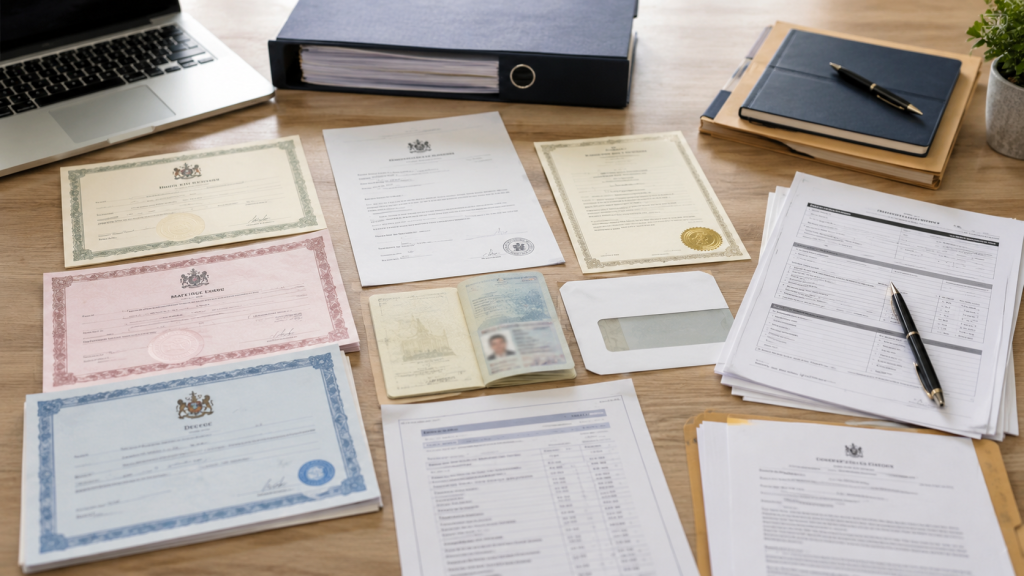
Public sector translation requests can involve many different document types. Some are personal records, while others relate to legal, professional, academic, medical, or business matters.
Common documents include:
- Birth certificates
- Marriage certificates
- Divorce certificates and decrees
- Death certificates
- Passports and identity documents
- Police clearance certificates
- Court orders and judgments
- Adoption documents
- Academic transcripts and degree certificates
- Professional qualification certificates
- Medical reports and vaccination records
- Employment letters and payslips
- Bank statements and financial records
- Tax documents
- Company registration documents
- Contracts, agreements, and procurement documents
For official use, the translation should normally be prepared from a clear copy of the full original document. If any part of the document is cropped, blurred, damaged, or missing, this can create questions during review and may delay acceptance.
Need an Official Document Translation for a UK Authority?
Send us a clear copy of your document and tell us where it will be submitted. We can review the file, confirm the likely translation format, and provide a clear quote and delivery timeline before work begins.
You can request a certified translation for public sector, legal, immigration, academic, medical, business, or personal document use.
Translation Specification in the UK: A Detailed Guide
Translation specifications in the UK are critical guidelines that outline the requirements for producing high-quality translations for official use. These specifications ensure that translations meet the necessary standards for accuracy, reliability, and acceptance by government bodies. Understanding these specifications is essential for anyone involved in the translation process.
One of the key aspects of translation specifications is the requirement for certified translators. Certified translators are expected to have a recognised qualification and demonstrate proficiency in both the source and target languages. This ensures that they possess the necessary skills to produce accurate translations that reflect the original document’s intent.
Additionally, translation specifications often dictate the need for a signed declaration from the translator. This declaration typically includes the translator’s name, contact information, and a statement affirming that the translation is a true and accurate representation of the original document. This requirement serves as a form of accountability and provides assurance to the receiving authority regarding the quality of the translation.
Another important element of translation specifications is the requirement for accuracy and completeness. Translations must convey the original document’s meaning, tone, and intent without omissions or alterations. For example, when translating legal documents, it is crucial to ensure that all legal terminology is accurately rendered to avoid potential legal issues.
Moreover, translation specifications may also dictate the use of specific terminology or formatting. Certain government bodies may have preferred terminology for specific types of documents, and adherence to these preferences is essential for acceptance. Additionally, the formatting of the translated document should closely resemble that of the original to maintain consistency and clarity.
To ensure compliance with translation specifications, it is advisable to follow a checklist that includes the following:
- Verify the qualifications of the translator to ensure they are certified and experienced.
- Ensure that the translation is accompanied by a signed declaration from the translator.
- Review the translation for accuracy and completeness, checking for any omissions or alterations.
- Confirm that the formatting of the translated document matches that of the original.
- Check for adherence to any specific terminology or formatting preferences outlined by the relevant government body.
In conclusion, understanding translation specifications in the UK involves recognising the importance of certified translators, signed declarations, accuracy, and adherence to specific terminology and formatting requirements. By following these guidelines, individuals and organisations can ensure that their translations meet the necessary standards for official use.
The Role of Certified Translators in Government Processes
Certified translators play a crucial role in ensuring that translations meet the necessary standards for government processes in the UK. Their expertise and qualifications are essential for producing accurate and reliable translations that are accepted by various governmental authorities.
One of the primary responsibilities of certified translators is to ensure that translations are completed to a high standard of accuracy. This involves not only translating the text but also understanding the context and nuances of the original document. For example, when translating legal documents, certified translators must be familiar with legal terminology and concepts to ensure that the translation accurately reflects the original intent.
Additionally, certified translators are often required to provide a signed declaration affirming the accuracy of their translations. This declaration serves as a form of accountability and provides assurance to the receiving authority that the translation has been completed by a qualified professional. This is particularly important for documents submitted to government bodies, as any inaccuracies can lead to delays or rejections.
Finding a certified translator in the UK can be done through various resources, including professional organisations such as the Institute of Translation and Interpreting (ITI) and the Chartered Institute of Linguists (CIOL). These organisations maintain directories of certified translators, allowing individuals and organisations to find qualified professionals for their translation needs.
Moreover, it is essential to verify the translator’s qualifications and experience before engaging their services. This can involve checking their credentials, reviewing their previous work, and ensuring that they have experience in the specific field relevant to the translation. For instance, a certified translator specialising in legal translations may not be the best choice for medical document translations.
In summary, certified translators play a vital role in government processes by ensuring that translations are accurate, reliable, and accepted by authorities. Their expertise and qualifications are essential for navigating the complexities of governmental requirements and ensuring that translated documents serve their intended purpose effectively.
Checklist Before Submitting a Translation to a UK Authority

Before submitting an official translation, check that the document is ready for review. This can reduce the risk of delays, follow-up questions, or rejection.
- The original document is complete and clearly readable
- All pages have been included
- Names, dates, reference numbers, stamps, and signatures are visible
- The translation includes a clear accuracy statement
- The translation includes the translation date
- The translator or translation company details are included
- The translated document is easy to compare with the original
- Any unclear or illegible parts of the source document are clearly marked
- You have checked whether the receiving body asks for certification, notarisation, or apostille
- You are submitting the original-language document together with the translation where required
If you are unsure what the receiving organisation expects, ask before submission or speak to a translation provider that regularly handles official document translations.
Challenges in Meeting UK Government Translation Standards
Meeting UK government translation standards can present several challenges for individuals and organisations seeking official translations. Understanding these challenges is crucial for ensuring that translations are completed accurately and meet the necessary requirements for acceptance by government bodies.
One of the most common pitfalls in translation is the risk of inaccuracies. Even minor errors in translation can lead to significant consequences, particularly for legal or immigration documents. For example, a mistranslation of a legal term could alter the meaning of a contract, leading to disputes or legal complications. To avoid such errors, it is essential to engage certified translators who are experienced in the relevant field and possess a deep understanding of the subject matter.
Another challenge is the requirement for specific formatting and terminology. Different government bodies may have varying preferences regarding the layout and terminology used in translated documents. Failure to adhere to these preferences can result in delays or rejections of applications. Therefore, it is crucial to verify the specific requirements of the relevant authority before submitting translated documents.
Additionally, the pressure of tight deadlines can pose challenges in meeting translation standards. When translations are needed urgently, there may be a temptation to compromise on quality or accuracy. However, rushing the translation process can lead to mistakes that could jeopardise the acceptance of the documents. It is advisable to allow sufficient time for the translation process to ensure that it is completed to a high standard.
Moreover, language nuances and cultural differences can also present challenges in translation. Certain phrases or terms may not have direct equivalents in the target language, leading to potential misunderstandings. Certified translators are trained to navigate these nuances and ensure that translations are culturally appropriate and contextually accurate.
In conclusion, the challenges in meeting UK government translation standards include risks of inaccuracies, specific formatting and terminology requirements, tight deadlines, and language nuances. By understanding these challenges and engaging qualified professionals, individuals and organisations can ensure that their translations meet the necessary standards for official use.
Common Mistakes to Avoid
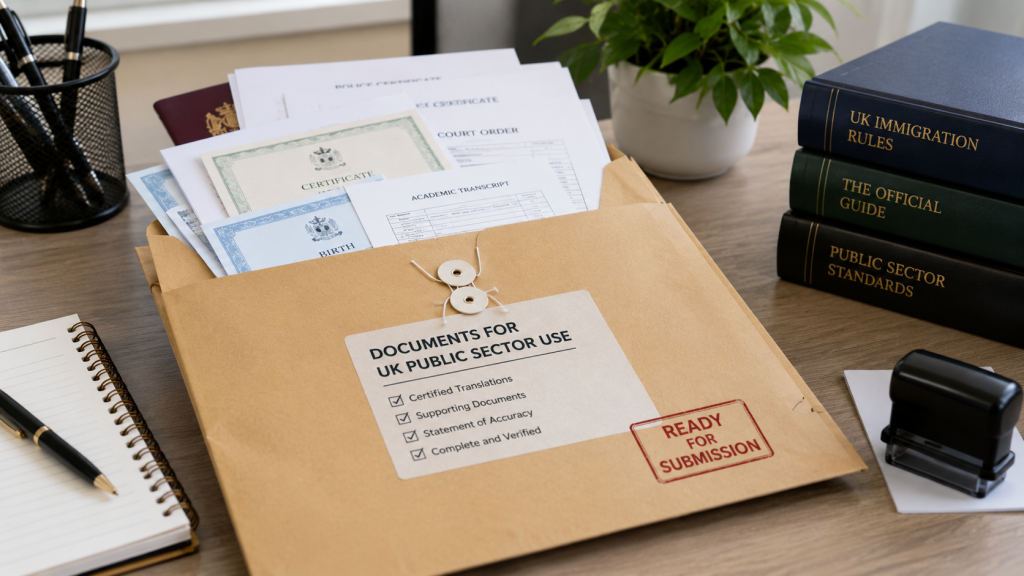
Many problems with official translations happen before the document is even submitted. The most common issues are usually avoidable with a careful review.
Avoid these mistakes:
- Sending only part of the original document
- Cropping out stamps, seals, signatures, or page numbers
- Using an informal translation for an official process
- Translating names or places inconsistently across documents
- Leaving handwritten notes, stamps, or annotations unexplained
- Forgetting to include the translator or translation company details
- Submitting a translation without checking the receiving body’s instructions
- Assuming notarisation or apostille is always required
- Waiting until the submission deadline before ordering the translation
A well-prepared translation should make the official review easier, not harder. Clear source files, accurate translation, and the right certification format all help the receiving authority process the document more smoothly.
Future Trends in Government Translation Standards
The landscape of government translation standards is evolving, influenced by advancements in technology and changing societal needs. Understanding these future trends is essential for individuals and organisations involved in the translation process, as they can impact the way translations are produced and accepted by government bodies.
One of the most significant trends is the increasing use of technology in the translation process. Machine translation and artificial intelligence are becoming more prevalent, offering faster and more cost-effective solutions for translating documents. However, while these technologies can assist in the translation process, they cannot fully replace the expertise and nuance provided by certified translators. As such, a hybrid approach that combines technology with human oversight is likely to become more common.
Additionally, the rise of digitalisation is transforming the way translations are submitted and processed by government bodies. Many agencies are moving towards electronic submissions, allowing for quicker processing times and improved efficiency. This shift necessitates that translators adapt to new formats and ensure that their translations meet the requirements for digital submissions, such as electronic signatures and secure file formats.
Moreover, there is a growing emphasis on inclusivity and accessibility in translation standards. Government bodies are increasingly recognising the importance of providing translations in multiple languages to accommodate diverse populations. This trend is particularly relevant in the context of immigration and public services, where accurate translations are essential for ensuring that all individuals can access necessary information and services.
Furthermore, the demand for specialised translations is on the rise. As globalisation continues to expand, there is an increasing need for translations in specific fields such as healthcare, law, and technology. This trend underscores the importance of engaging certified translators who possess expertise in the relevant subject matter to ensure that translations are accurate and contextually appropriate.
In conclusion, future trends in government translation standards include the increased use of technology, the digitalisation of submission processes, a focus on inclusivity and accessibility, and a growing demand for specialised translations. By staying informed about these trends, individuals and organisations can better navigate the evolving landscape of government translation standards.
Questions Clients Often Ask
What is official document translation for the public sector?
Official document translation for the public sector means translating a document so it can be used by a government department, court, council, university, healthcare provider, or other public body. The translation often needs to be certified so the authority can verify who completed it and when.
Do public sector bodies accept normal translations?
Some public bodies may accept a standard translation for general information, but official applications usually require a certified translation. If the document affects immigration, legal status, education, healthcare, finance, or official records, certification is often expected.
What should a certified translation include?
A certified translation should usually include a statement confirming that the translation is true and accurate, the date of translation, and the translator or translation company’s details. Some authorities may also ask for a signature, stamp, or additional formatting.
Do I need notarisation for a public sector translation?
Not always. Many UK public sector submissions only require a certified translation. Notarisation may be needed for certain legal, overseas, or authority-specific purposes. It is best to check the receiving organisation’s instructions before ordering.
Can I translate my own document for a UK authority?
For official use, translating your own document is usually risky because the receiving organisation may need an independent translation that can be verified. A professional certified translation is usually safer for public sector submission.
Should I send the original document with the translation?
In many official processes, the receiving body may ask to see the original-language document together with the translation. You should check the submission instructions and keep a copy of both documents.
What if part of my document is unclear or damaged?
If part of the source document is unclear, cropped, handwritten, or damaged, the translator should handle it transparently rather than guessing. The unclear wording may be marked as illegible or noted appropriately in the translation.
How long does official document translation take?
Turnaround depends on the language, document length, formatting, and whether certification, notarisation, or additional checks are needed. Simple certificates may be completed faster than long legal, medical, or business documents.
What are the UK government translation requirements?
There is no single set of UK government translation requirements covering every authority. Requirements vary by application and receiving body. For example, some processes require an accuracy statement, translation date and translator contact details, while others may specify additional certification, notarisation or legalisation steps.
What is the government accepted translation format?
There is no universal government-accepted template. Use the receiving body’s current instructions. A complete translation, an accuracy statement where required, identifying/contact details and a clear relationship to the source document are common elements.
How can I find a certified translator in the UK?
You can find a certified translator in the UK through professional organisations such as the Institute of Translation and Interpreting (ITI) or the Chartered Institute of Linguists (CIOL). These organisations maintain directories of certified translators, allowing you to verify their qualifications and experience in the relevant field.
What challenges might I face with government translation standards?
Common challenges in meeting government translation standards include the risk of inaccuracies, specific formatting and terminology requirements, tight deadlines, and language nuances. Engaging certified translators and allowing sufficient time for the translation process can help mitigate these challenges.
What is the importance of official translation standards?
Official translation standards are essential for ensuring accuracy and legality in translated documents. They facilitate acceptance by government bodies and help prevent complications that may arise from inaccuracies or non-compliance with requirements.