Understanding Malay to English Translation for UK Official Use
Malay-to-English translation may be needed when a UK organisation cannot use a Malay document as submitted. The documents that need translation, and any certification details required, depend on the receiving organisation and the purpose of the submission.
Common documents that often require translation include:
- Birth Certificates: Often needed for visa applications or citizenship processes.
- Marriage Certificates: Essential for spouse visa applications and legal recognitions.
- Academic Transcripts: Required for university admissions or professional registrations.
- Legal Documents: Such as contracts, affidavits, and court orders, which must be accurately translated for legal proceedings.
- Medical Records: Necessary for healthcare services or immigration health assessments.
Each of these documents serves a specific purpose and must be translated with care to ensure that all details are conveyed accurately. This is particularly important in the context of UK official use, where the standards for translation are stringent.
The Malay Document Translation Process
The process of translating Malay documents into English involves several critical steps to ensure accuracy and compliance with UK regulations. Here’s a step-by-step guide:
- Identify the Type of Document: Understanding the nature of the document is crucial. Different documents may have varying requirements for translation, especially concerning certification.
- Choose a Qualified Translator: Selecting a translator who is not only fluent in both languages but also familiar with the specific terminology of the document type is essential. Look for translators with relevant qualifications and experience in the field.
- Provide Context: When submitting the document for translation, provide any necessary context or background information. This helps the translator understand the document’s purpose and ensures that the translation is appropriate for its intended use.
- Review and Revise: Once the translation is complete, review it for accuracy. If possible, have a second translator or a native speaker review the document to catch any potential errors or nuances that may have been overlooked.
- Obtain Certification if Required: For many official uses, a certified translation is necessary. This means that the translator must provide a signed statement attesting to the accuracy and completeness of the translation.
Choose a provider with Malay-to-English experience and familiarity with the document type and intended recipient. ITI, CIOL or other professional memberships can be useful quality signals, but no single membership is universally required for UK official use.
Certified Translation: What You Need to Know
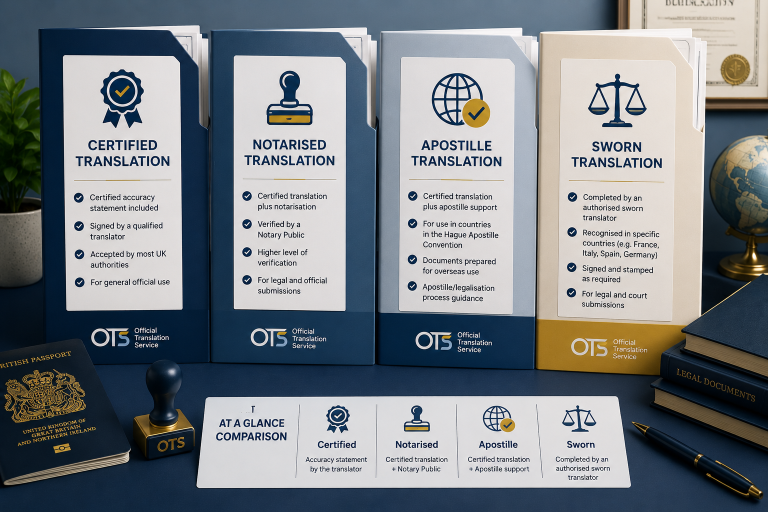
A certified translation includes a signed statement confirming the translation’s accuracy and completeness. Certification is required in some official contexts, but the receiving organisation decides whether it is needed and what details it must contain.
Definition of Certified Translation: A certified translation is one that has been translated by a qualified translator who provides a signed statement confirming that the translation is a true and accurate representation of the original document. This certification is often necessary for legal and official purposes.
When is Certification Required for UK Use? Certification is typically required in the following scenarios:
- Legal Documents: Courts and legal professionals may require translation or certification for particular documents, but the requirement depends on the proceeding and recipient.
- Immigration Purposes: If an immigration route requires supporting evidence that is not in English or Welsh, follow that route’s current translation and certification instructions.
- Education Applications: Universities and colleges set their own requirements for translated transcripts, diplomas and other academic evidence.
Not all translations require certification. Check the receiving organisation’s instructions before ordering rather than adding certification, notarisation or other steps that may not be needed.
Additionally, the certification process can vary depending on the translation service provider. Some may include certification as part of their service, while others may charge an additional fee. Always clarify these details before proceeding with the translation.
Malay Translation for UKVI: Key Requirements
The UK Visas and Immigration (UKVI) has specific requirements for translations submitted as part of visa applications. Understanding these requirements is essential for a successful application process. Here are the key requirements:
- Language and document expertise: Use a provider with the appropriate Malay-to-English skills and document experience. Professional-body membership is not a universal requirement.
- Certification: Where the immigration route requires translation, include the certification details specified by that route, commonly including an accuracy statement and identifying/contact information.
- Document Format: Translate the document completely and present names, dates, figures, stamps, signatures and annotations clearly. An identical visual layout is not a universal requirement.
- Completeness: Every part of the original document must be translated, including any annotations or comments. Incomplete translations can lead to delays or rejections.
Specific documents that often require translation for UKVI purposes include:
- Birth Certificates: Required for proving identity and familial relationships.
- Marriage Certificates: Necessary for spouse visa applications.
- Academic Qualifications: Required for student visa applications to demonstrate educational background.
- Financial Documents: Such as bank statements, which may need to be translated to prove financial stability.
If a required translation does not follow the relevant route’s instructions, corrected evidence may be requested and processing can be delayed. Check the current guidance for the application being made.
Common Challenges in Malay to English Translation
Translating documents from Malay to English presents several challenges that can affect the accuracy and quality of the translation. Understanding these challenges can help in selecting the right translator and ensuring a successful outcome. Here are some common issues:
- Cultural Nuances: Malay and English are rooted in different cultures, which can lead to misunderstandings if cultural references are not properly conveyed. For example, idiomatic expressions in Malay may not have direct equivalents in English, requiring the translator to find alternative ways to express the same idea.
- Technical Terminology: Different fields, such as legal, medical, or technical, have their own specific terminologies. A translator must be familiar with the relevant jargon to ensure accurate translations. For instance, legal terms in Malay may not have a direct counterpart in English, necessitating careful consideration of context.
- Maintaining Context and Meaning: The translator must ensure that the original meaning is preserved while adapting the text for the target audience. This can be particularly challenging when dealing with complex sentences or concepts.
To mitigate these challenges, it is crucial to choose a translator with expertise in the relevant field and a deep understanding of both languages. Providing context and background information can also help the translator deliver a more accurate and culturally sensitive translation.
Tips for Choosing the Right Translation Service
Selecting the right translation service is essential for ensuring high-quality translations. Here are some factors to consider when making your choice:
- Qualifications and Experience: Check Malay-to-English and document-type experience. Professional credentials can be useful quality signals, but the receiving organisation’s requirements are what matter for acceptance.
- Specialization: Different translators may specialize in various fields, such as legal, medical, or technical translations. Ensure that the translator you choose has experience in the relevant area to guarantee accuracy.
- Client Reviews and Testimonials: Research client feedback and testimonials to assess the quality of the translation service. Positive reviews can indicate reliability and professionalism.
- Turnaround Time: Consider the urgency of your project and ensure that the translation service can meet your deadlines. Discuss timelines upfront to avoid any surprises.
- Cost: While cost should not be the sole deciding factor, it is important to understand the pricing structure. Ask for a detailed quote and inquire about any additional fees for certification or expedited services.
Asking potential translators specific questions can also help you gauge their suitability. Consider inquiring about their translation process, how they handle revisions, and their familiarity with UKVI requirements if applicable.
Cost Factors for Malay to English Translation Services
The cost of translating documents from Malay to English can vary widely based on several factors. Understanding these factors can help you budget appropriately for your translation needs:
- Document Length: Longer documents typically cost more to translate due to the increased time and effort required. Pricing is often calculated per word or per page.
- Complexity of Content: Technical or specialized documents may incur higher costs due to the need for expertise in specific terminology and concepts.
- Urgency of the Project: If you require a quick turnaround, many translation services will charge a premium for expedited services.
- Certification Requirements: If a certified translation is needed, this may involve additional fees for the certification process.
- Translator’s Experience: More experienced translators may charge higher rates, but their expertise can ensure a higher quality translation.
It is advisable to obtain quotes from multiple translation services to compare prices and services offered. Be sure to clarify what is included in the quoted price to avoid any unexpected costs later on.
The Role of Technology in Document Translation
Technology plays an increasingly significant role in the field of document translation. Various tools and software can assist translators in improving efficiency, accuracy, and consistency. Here are some key aspects of technology in translation:
- Translation Software: Tools like CAT (Computer-Assisted Translation) software help translators maintain consistency across large projects by creating translation memories and glossaries. This can be particularly beneficial for technical documents.
- Machine Translation: Services like Google Translate can provide quick translations for basic text. However, while machine translation has improved significantly, it often lacks the nuance and context required for official documents.
- Collaboration Tools: Online platforms allow translators to collaborate with clients and other translators in real-time, facilitating smoother communication and quicker turnaround times.
Despite the advantages of technology, it is essential to remember that human oversight is crucial. Automated translations can miss cultural nuances and context, making human translators indispensable for high-quality translations.
Conclusion: Ensuring Quality in Malay to English Translation
Quality translation from Malay to English is vital for individuals and businesses engaging with UK official processes. Understanding the translation process, the importance of certification, and the specific requirements for UKVI can significantly impact the success of your applications. By choosing a qualified translator, being aware of common challenges, and considering the role of technology, you can ensure that your translations meet the necessary standards.
Investing in professional translation services not only enhances the accuracy of your documents but also provides peace of mind, knowing that your translations are in capable hands. For those navigating the complexities of official documentation in the UK, the right translation service can make all the difference.
Frequently Asked Questions
What is the process for translating Malay documents to English?
The process involves identifying the type of document, selecting a qualified translator, and obtaining a certified translation if needed.
When is a certified translation required for UK official use?
A certified translation is required only where the receiving organisation or applicable process asks for one. Check the recipient’s current instructions before ordering.
How can I ensure the quality of my Malay to English translation?
To ensure quality, choose a provider with relevant language-pair and document experience, check its quality process, and confirm that the output matches the receiving organisation’s requirements.
What are the common challenges in translating Malay documents?
Common challenges include cultural nuances, technical jargon, and maintaining context and meaning.
What factors influence the cost of Malay to English translation services?
Factors influencing cost include document length, complexity of content, and urgency of the project.